
Auxin: the master regulator of root and shoot growth
What auxin does in roots, shoots, branching and fruit, why too much is as bad as too little, and what growers can do to protect it.
Read the next partRoots grow downward because of gravitropism: cells in the root tip sense gravity and shift the plant hormone auxin, so the root bends toward the soil. Biostimulants do not switch this on. Selected seaweed, amino acid and humic products can support root growth, nutrient uptake and stress tolerance, but only after you find out why the roots are weak.
Part 1 of 6 in the Plant Science Series by Gafar Laiya: plant physiology and biostimulant science, in plain language. Published 30 October 2026.
Plants have no eyes or muscles, yet a root knows which way is down. Cells in the root tip contain small starch-filled grains called amyloplasts. They settle to the lower side of the cell, and that tells the plant which way gravity points.
The signal changes how the growth hormone auxin is spread. In a root, more auxin on the lower side slows growth there, so the root bends downward. In a shoot, more auxin on the lower side speeds growth there, so the shoot bends upward. That is why a seed sown at any angle still sends its root down and its shoot up.
Side roots grow at an angle, not straight down, so the plant can search a wider volume of soil. Gravity is also not the only cue. Roots respond to water, oxygen and nutrient-rich patches as well, which is why moisture and soil condition shape the root system as much as gravity does.
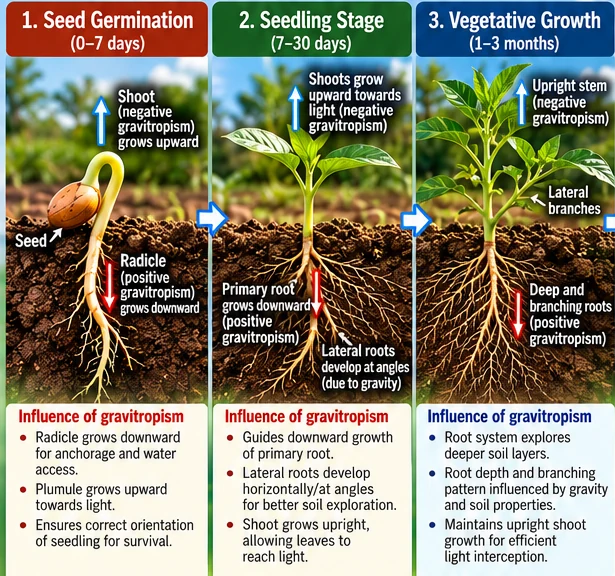
Illustration of the first three crop stages: the root grows down (positive gravitropism) and the shoot grows up (negative gravitropism).
| Stage | What the roots are doing | What can go wrong | What growers can check |
|---|---|---|---|
| Germination | The first root (radicle) pushes down for water and anchorage | Crust, dry soil, poor seed or cold soil | Seed quality, moisture, depth of sowing |
| Seedling | The main root and side roots begin to branch | Transplanting shock, salt, compaction | Handling at transplant, irrigation water quality |
| Vegetative growth | Roots explore deeper layers for water and nutrients | Shallow roots, waterlogging, nutrient imbalance | Root depth, drainage, soil test |
| Flowering and fruiting | Roots must keep supplying a high demand for water and nutrients | Heat and moisture stress, root damage | Steady irrigation, root health, nutrient supply |
| Grain or fruit fill | Roots stay active to support filling | Early root decline, stress | Water supply and plant health late in the crop |
A biostimulant is not a fertilizer and not a pesticide. It helps the plant use nutrients better and cope with stress. It does not replace gravity sensing, and it does not fix a hard, salty or waterlogged soil by itself. Effects depend on the active ingredient, the formulation, the crop, the soil and the weather.
| Problem in the field | Check first | Approach that may help |
|---|---|---|
| Poor root growth | Compaction, drainage, soil test | Fix soil first; seaweed or amino acid products to support roots |
| Transplanting shock | Root damage, watering after transplant | Careful handling plus a stress-support product at transplant |
| Salinity | Soil and water EC | Better water and drainage first; products evaluated for stress tolerance can support |
| Poor use of fertilizer | Soil test, balance of nutrients | Balanced nutrition; humic substances and suitable microbial products can support uptake |
| Uneven crop establishment | Seed, sowing depth, moisture | Good seed and moisture; early-stage applications can support even growth |
| Heat or moisture stress | Irrigation schedule, mulch | Crop-specific stress management at sensitive stages |
No single product solves every problem. Start with the cause, then choose the product.
Farming has long asked only how much fertilizer to apply. A better question is whether the roots can use what is already in the soil. Is the root system growing well? Is the plant under salt or water stress? Is the soil alive and rich in organic matter? Biostimulants have a place in this thinking, when they are properly formulated, matched to the problem and tested in the field.
Tell us your crop, stage and what you see in the roots, and we will suggest a programme. Send an enquiry or see the Immunity range.
Written by Gafar Laiya, founder of Gujarat Bio Organics, working with farmers since 2006. Results differ from farm to farm with soil, weather, crop and management. Farmer experiences on this site are their own reports, not a promise of results.
It is the way plants sense gravity and grow accordingly: roots grow down and shoots grow up.
No. Gravity decides the direction. Biostimulants may support the growth, nutrient uptake and stress tolerance of the roots, depending on the product, crop and soil.
It depends on the cause. Seaweed extracts, amino acids and humic substances are commonly used to support roots, but check soil, drainage and salinity first.
Dig up a few weak plants and a few healthy ones and compare the roots. Short, brown, slimy or shallow roots, or roots that stop at a hard layer, show a problem.
No. They help the crop use nutrients better, but the crop still needs balanced nutrition.
Only products listed in Schedule VI of the Fertiliser Control Order are allowed. Ask the supplier for proof of listing.
These are starting points for readers who want to look at the research. Findings differ between crops, products and conditions.
What auxin does in roots, shoots, branching and fruit, why too much is as bad as too little, and what growers can do to protect it.
Read the next partSee all six parts of the Plant Science Series.
Technical notes on our business site (b2b.gujaratbio.com), for manufacturers, importers and brand owners:
Biostimulant manufacturer in India: bulk, private label and export
Tell us your crop, the problem and your location, and send a photo if you can. Our team replies on WhatsApp or calls you with what to check, which product suits and where to buy it near you.
Need bulk supply, OEM or private label? Our business site has grades, specifications and export terms.