
Reality check
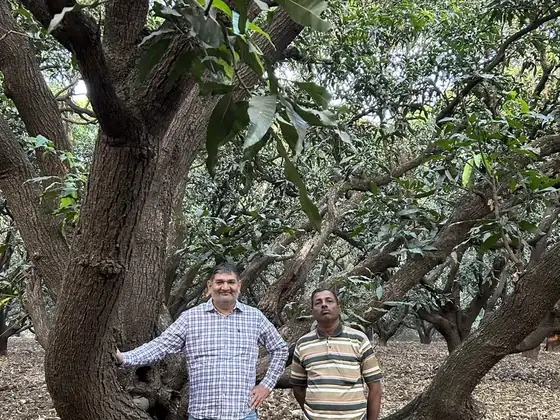
Planting twice the trees does not give twice the mangoes. Without yearly pruning, close-planted Kesar crowds itself out, and researchers in Gujarat have seen exactly that happen.
Most new Kesar orchards in Gujarat are planted at 5 x 5 m, and some at 5 x 2.5 m. Closer spacing gives more fruit per acre in the early years, but only if you prune every year to keep each tree small. Without that commitment, close-planted Kesar becomes crowded and yields fall.
Common spacings
| Spacing | Trees per acre | What it means |
|---|---|---|
| 10 x 10 m (traditional) | About 40 | Large trees, slow to full yield, little pruning |
| 5 x 5 m (high density) | About 160 | The common choice for new Kesar orchards |
| 5 x 2.5 m (closer) | About 320 | Needs yearly pruning without fail |
| 3 x 2 m (ultra high density) | About 670 | Under research for Kesar; no university recommendation yet |
Trees per acre are rounded arithmetic (1 acre = about 4,047 m2). Navsari Agricultural University began a trial of very close spacing with Kesar in 2025; results are not yet out.
Why close planting fails for many growers
- Kesar is a vigorous tree. Left alone, neighbouring canopies touch within a few years.
- Crowded trees shade each other, flower less inside the canopy, and hold hoppers and mildew.
- Heavy pruning to recover a crowded orchard then cuts yield for a season or more.
- Researchers at Navsari Agricultural University note that earlier attempts at closer Kesar planting failed from overcrowding and excess pruning; growers who succeed commit to pruning every year.
The yearly pruning window
Prune right after harvest, so new shoots have time to mature before winter. A Navsari Agricultural University study on high density Kesar found that pruning in the first fortnight of July, cutting back about 25 cm of the shoots, gave better fruit set and yield than later pruning or no pruning. Pruning in winter, close to flowering, removes the shoots that would have flowered.
What to plan before planting
- Water: drip irrigation is close to essential for high density, to control water before flowering and feed through the season.
- Labour: yearly pruning of every tree, plus closer spraying and harvesting work.
- Soil: deep, well-drained land. Kesar does poorly where water stands after rain.
- Plants: grafts from a known, healthy mother orchard.
- Training: shape each young tree with a short trunk and open centre from the first year.
- Patience: high density brings fruit per acre earlier, but no spacing makes an unfed tree productive.
Related guides
Mango flowering care, alternate bearing, fruit drop and the mango crop guide.
Sources
- Navsari Agricultural University: experiment on close spacing in mango (2025-2030)
- Solanki and Shah, NAU: time and intensity of pruning in high density Kesar
Written by Gafar Laiya, founder of Gujarat Bio Organics, working with farmers since 2006. Results differ from farm to farm with soil, weather, crop and management. Farmer experiences on this site are their own reports, not a promise of results.
Questions
What is the best spacing for high density Kesar mango?
5 x 5 m is the most common for new Kesar orchards in Gujarat. 5 x 2.5 m is used by growers who prune every year. Closer spacings are still being researched.
How many Kesar mango plants per acre in high density?
About 160 at 5 x 5 m and about 320 at 5 x 2.5 m.
When should I prune high density mango?
Right after harvest. A Navsari Agricultural University study found the first fortnight of July best for high density Kesar.
Is high density mango profitable?
It can bring fruit per acre earlier, but only with drip irrigation and yearly pruning. Without them, crowded trees yield less.
Send us your enquiry
Tell us your crop, the problem and your location, and send a photo if you can. Our team replies on WhatsApp or calls you with what to check, which product suits and where to buy it near you.